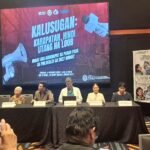
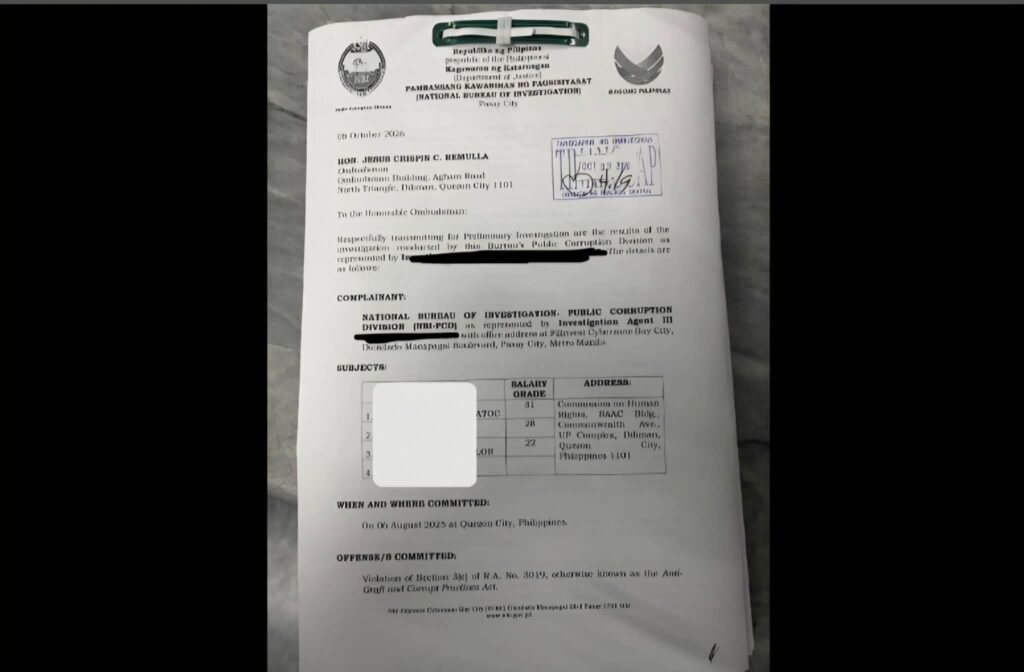

Commission on Human Rights (CHR) Chairperson Richard Palpal-Latoc has been named in a complaint filed before the National Bureau of Investigation (NBI) over alleged irregularities in the claiming and processing of travel-related expenses for an international human rights training program.
The complaint, reportedly filed on October 9, 2026, also names three other officials identified as CUYCO, DOLOR, and MANI. It alleges violations of Section 3(e) of Republic Act No. 3019, or the Anti-Graft and Corrupt Practices Act, as well as gross misconduct.
In a statement, CHR spokesperson Commissioner Beda Epres said the Commission was aware of information circulating online concerning the allegations.
“The CHR recognises the seriousness of these concerns, particularly as they relate to the responsible use of public funds and the accountability expected of government officials,” Epres said.
According to the complaint, Palpal-Latoc attended the 54th International Institute of Human Rights Summer School 2025, a month-long training program whose airfare, accommodation, meals, and subsistence were allegedly fully funded by the Friedrich Naumann Foundation for Freedom (FNF).
Despite the reported sponsorship, the complaint alleges that the CHR chairperson claimed daily subsistence allowance and representation expenses for the same period, raising questions about compliance with Executive Order No. 77, series of 2019, which governs official travel expenses of government personnel.
The complainant also cited Section 16(b) of the executive order in questioning the claimed representation expenses.
Questions Over Travel Documents
The complaint further alleges that the disbursement voucher failed to disclose the foreign donor that funded the trip.
It also points to an alleged discrepancy in the supporting documents, claiming that the program agenda attached to the voucher covered the 53rd Summer School, held from June 24 to July 19, 2024, rather than the 2025 session identified in the disbursement voucher, Authority to Travel, and Actual Itinerary.
The filing also questions the processing of the voucher, alleging that MANI certified the supporting documents as complete, DOLOR certified the availability of funds, and CUYCO approved the voucher for payment despite the purported deficiencies.
The complainant argues that the circumstances warrant an investigation into whether public funds were improperly disbursed and whether the officials involved may be held accountable under applicable laws and regulations.
CHR Says It Has Not Received Formal Complaint
Despite the allegations, Epres said the CHR had not received a formal complaint concerning the matter at the time of its statement.
“At this time, the CHR has not received any formal complaint concerning the allegations,” the spokesperson said.
Nevertheless, Epres stressed the importance of establishing the facts through appropriate processes and in accordance with government accounting and auditing rules and the requirements of due process.
“The CHR remains committed to ensuring that the concerns raised are addressed through the proper channels and will provide further information as appropriate,” Epres said.
Investigation and Due Process
Section 3(e) of RA 3019 penalizes certain acts of public officers that cause undue injury to the government or another party, or grant a private party unwarranted benefits, advantage, or preference through manifest partiality, evident bad faith, or gross inexcusable negligence.
The complaint seeks to establish whether the questioned claims and the processing of the disbursement voucher constitute violations of the law and applicable administrative rules.
The allegations, however, have yet to be established through the appropriate proceedings. The filing of a complaint does not automatically establish criminal or administrative liability.
The National Bureau of Investigation is the agency before which the complaint was reportedly filed. The CHR has said it will provide further information as appropriate.