
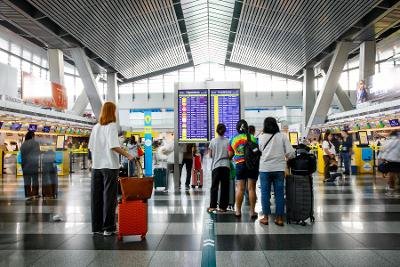

This scene at NAIA Terminal 3 reflects part of ongoing improvements at the airport, as international passenger traffic rose 2.6% year-on-year to 19.93 million from Jan. 1 to Oct. 22, 2026.
International passenger traffic at Ninoy Aquino International Airport (NAIA) rose 2.6% year-on-year to 19.93 million from January 1 to October 22, 2026, despite disruptions to global aviation from the Middle East conflict.
NAIA operator New NAIA Infra Corp. (NNIC) said the airport handled 507,772 more international passengers than the 19.42 million recorded during the same period last year. Growth continued into October, with traffic rising 2.05% to 1,389,882 passengers in the first 22 days of the month.
“It’s encouraging to see international passenger traffic continuing to grow despite the challenges affecting aviation worldwide. It shows that demand for travel to and from the Philippines remains strong,” NNIC General Manager Lito Alvarez said. “Our responsibility is to make sure NAIA can support that demand with better facilities, more reliable operations, and a better experience for passengers.”
International passengers accounted for 48.1% of NAIA’s total traffic, up from 46.6% a year earlier. Domestic passenger volume, by comparison, declined 3.4% to 21.49 million.
Airlines are also adding new international services to Manila or announcing plans for additional routes. Air France has resumed services to the Philippines, while Philippine Airlines (PAL) is set to launch nonstop flights to Chicago in November and to Delhi and Mumbai in December, subject to regulatory approval for the Indian routes.
Delta Air Lines is scheduled to launch nonstop flights between Los Angeles and Manila in March 2027, initially operating three times weekly before expanding to daily service in June. Indian carrier IndiGo is also expected to introduce services to Manila, further expanding travel options between the Philippines and overseas markets.
NAIA ranked sixth globally for international low-cost carrier connectivity in aviation data provider OAG’s 2026 Megahubs index, highlighting its position as a major gateway for budget international travel.
The increase in international traffic has coincided with improved operational performance at NAIA. System-wide on-time performance rose to 81.07% from January 1 to October 22, 2026, from 77.92% during the same period last year.
The 3.15-percentage-point improvement comes as NNIC continues to modernize the airport while maintaining daily operations. On-time arrivals averaged 82.09%, while departures recorded 80.05%.
NAIA handled a record 52 million passengers in 2025, surpassing its original design capacity of 35 million annually. NNIC has been upgrading facilities while keeping the airport operational.
Meanwhile, NNIC has spent more than P6.8 billion on completed and ongoing airport improvements, including 78 automated immigration e-gates at Terminals 1 and 3, expanded curbside, transport and parking facilities, improved wayfinding, and upgrades to passenger waiting areas, lounges, restrooms, boarding facilities and other terminal infrastructure. Food and retail options have also expanded across the terminals.
Ongoing projects include upgrades to the control tower and its systems, improvements to baggage handling and power infrastructure, and expanded aircraft handling facilities. The new North Wing Bus Gate at Terminal 2 and additional passenger boarding bridges are expected to become operational soon.
Under its public-private partnership agreement, NNIC is responsible for operating and modernizing NAIA while remitting a share of airport revenues to the government. As of October 15, 2026, these remittances had reached P83.6 billion since the company took over operations in September 2024.
Reference:
Nathaniel C. Barretto
 SMC Media Affairs Group